
Spring Slim Down!

Hopefully Spring will actually arrive soon!
In the meantime, it is time to get ready for the shorts and bathing suits!
Have you gained a few extra pounds over the winter and in need of a Spring Slim Down? Here are a few tips to shed a few unwanted pounds:
Start your day with a healthy serving of protein such as a smoothie or egg whites. Protein for breakfast will help to manage blood sugar levels and curb sugar cravings throughout the day.
Try to eat smaller balanced meals every 4 hours. This will also help with blood sugar and will also help to boost your metabolic rate.
Eat your carbohydrates (breads and grains) earlier in the day, lunch is best. This will give the body time to convert the sugar from carbs into energy and you store less fat than if you ate the carbs later in the day. Try to make your carb cut off time 4pm!
Avoid eating in the evening. Try a nice herbal tea in place of the night time snacks.
Increase diurectic foods such as asparagus, spinach, berries and artichokes. These foods will keep your cells hydrated and naturally detox your liver.
Form and Function offers specific Weight Loss Programs to help to achieve your optimal weight. Log on our website today for information!
In good health!
Mary

Spring into Action!

Spring is arriving soon! As the weather gets warmer, a lot of people want to start a new exercise routine or get back to an activity they have done before. Be careful! Injuries are extremely common during this time of year. Here are some tips to start/return to spring activities and minimize injury.

Starting a new activity
If you are trying something new, make sure you do it within reason! For example, if you are starting running, doing it 5 days a week is definitely too much. Try giving at least a day or two in between to rest your body and allow healing. That translates to roughly 3 times a week at most. Do this for at least 2-3 weeks before increasing your activity level. By easing yourself into the activity, you have a lower chance of sustaining an injury.

Returning to an activity
“I was only doing ____insert activity here_____ the same amount of times per week as last spring. Why am I injured?” If you have not been doing an activity all winter, do not judge your activity level based on your performance last year. It only takes muscles 2 weeks to start shrinking and to get weaker so you must ease yourself back into activity. Conversely, it takes roughly 2 weeks to start building muscle again so start gently and let your body build up the necessary muscles to do your activity. Start off with 2-3 times a week at most for 2-3 weeks. You can then increase your activity level.

Injury prevention
Unfortunately, even if you ease yourself into activity, not all injuries can be prevented.  However, you can take further steps to minimize injury. No matter what physical activity you are interested in (ie running, gardening, tennis, etc.) there are physical demands needed on your body. You can talk to a Physiotherapist or Chiropractor to develop a personalized resistance training program that will strengthen the muscles needed for your activity. Doing these exercises as prescribed can help minimized potential acute traumatic or repetitive stress injuries.

Furthermore, listen to your body! I cannot stress this enough. It is normal to be sore after exercising but you should not be in pain. Let the soreness subside before doing the activity again. If you are in pain, see a Physiotherapist or Chiropractor.

I will use running for one last example but you can substitute any activity into this phrase. Remember:

“If you are planning to run to get fit, you should be fit to run first!”

Manni Wong, Registered Physiotherapist

Internship program: taking new resumes

Form & Function is currently seeking 3 new interns for the upcoming June 2013- Dec 2013 term. The applicants should have a university degree or is in the progress of completing one. Hours are flexible, but 8 hour minimum is required for the week. This is a very hands on experience with tons of educational and research bits that will make you a better sports based practitioner in the future. Please send all resumes and cover letter to this ad. The ad will be deleted when 20 resume quota is reached.

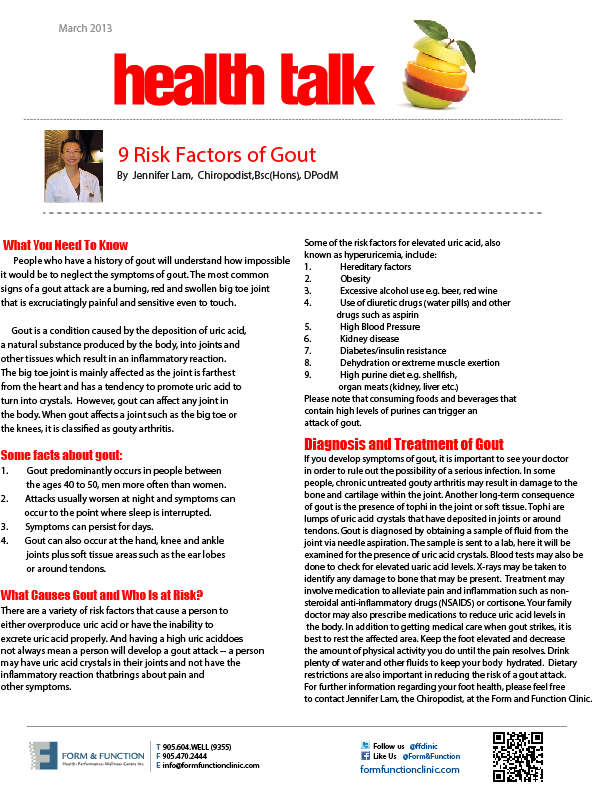
March Health Talk 9: Risk Factors of Gout

Great health talk newsletter on Gout prevention by Markham Chiropodist Jenny Lam  Please subscribe to our newsletter on the right for future health tips and health talk newsletters!

March Health Talk 9: Risk Factors of Gout

Great health talk newsletter on Gout prevention by Markham Chiropodist Jenny Lam  Please subscribe to our newsletter on the right for future health tips and health talk newsletters!

Relieve the stress from your desk

Does your desk cause you pain?  What can I do to relieve the tightness in my shoulders or neck?  If you have asked yourself these questions, I have a few suggestions that can help.

  • Raise your monitor.  The top of your monitor screen should be at eye level.  This will allow you to sit in an upright posture without looking down.  When the monitor is too low it pulls your head forward which increases the strain on your neck.
  • Support your forearms/elbows.  When you have to constantly hold up your arms your shoulder/trapezius muscles are always on.  Use your desk or the arm rests on your chair to give your shoulders a break.
  • Take a break every 45 min.  Change postures (recline in your chair, shift in your seat, etc.) or get up out of your chair.  This will not allow you to build up the stress in your tissues that can lead to tightness and pain.
  • Get more strategies and treatment from your healthcare professional.  I always give my patients specific strategies to help them with the stress from their desk.  The key is not to let the tension build up in the tissues and utilize strategies (i.e. stretching, postural changes & movement strategies) that can break the stress building cycles.

For more information please contact me.

Dr. Paul

Relieve the stress from your desk

Does your desk cause you pain?  What can I do to relieve the tightness in my shoulders or neck?  If you have asked yourself these questions, I have a few suggestions that can help.

  • Raise your monitor.  The top of your monitor screen should be at eye level.  This will allow you to sit in an upright posture without looking down.  When the monitor is too low it pulls your head forward which increases the strain on your neck.
  • Support your forearms/elbows.  When you have to constantly hold up your arms your shoulder/trapezius muscles are always on.  Use your desk or the arm rests on your chair to give your shoulders a break.
  • Take a break every 45 min.  Change postures (recline in your chair, shift in your seat, etc.) or get up out of your chair.  This will not allow you to build up the stress in your tissues that can lead to tightness and pain.
  • Get more strategies and treatment from your healthcare professional.  I always give my patients specific strategies to help them with the stress from their desk.  The key is not to let the tension build up in the tissues and utilize strategies (i.e. stretching, postural changes & movement strategies) that can break the stress building cycles.

For more information please contact me.

Dr. Paul

TORN ACL!


I have been seeing many ruptured ACL patients in the past  few years, and I have seen great success with our rehab programs. But the question still remains… to cut or not to cut? My past experience aligns with the current research of the benefits vs risks of ACL reconstruction, the evidence is clear; just do it! I have seen too many patients that refuse the surgery and have multiple instances of “giving out” or aberrant movement inside the knee joint. This will lead to cartilage tears, meniscus tears, synovitis, other ligamentous damage, and eventually osteoarthritis later on in life. This is especially true for active population; don’t mention all the psychosomatic sequela associated with a torn ACL effecting your sports performance.

ICE VERSUS HEAT?

There is often confusion around the application of ice or heat when managing injuries. It is important to know the purpose of each modality and recognize when one form of therapy is warranted over the other. Let’s begin with the application of ice, also known as cryotherapy. Cryotherapy is aimed at decreasing pain and inflammation following an acute (rapid onset) injury to the musculoskeletal system. It is the best immediate treatment for acute injuries as it works to vaso-constrict blood vessels (causes blood vessels to narrow) which limits internal bleeding and swelling at the injury site. The cardinal signs and symptoms of an acute injury or active inflammation are:
• Pain
• Redness
• Skin that is warm to touch
• Swelling
• Loss of function

Icing is indicated if any of these signs and symptoms are present. To ice an injury, wrap ice in a thin towel (preferably a wet towel) and place it on the affected area for 10 minutes at a time. Allow the skin temperature to return to normal before icing a second or third time. You can ice an acute injury several times a day for up to three days. Cold therapy is also helpful in treating some overuse injuries or chronic pain in athletes. For example, an athlete who has chronic knee pain that increases after running may want to ice the injured area after each run to reduce or prevent inflammation.

Heat is generally used for chronic (long lasting) injuries or injuries that have no inflammation or swelling. Sore, stiff, nagging muscle or joint pain is ideal for the use of heat therapy. Athletes with chronic pain or injuries may use heat therapy before exercise to increase the elasticity of joint connective tissues and to stimulate blood flow via vaso-dilation of blood vessels (causes blood vessels to expand). Heat can also help relax tight muscles or muscle spasms. Don’t apply heat after exercise. After a workout, ice is the better choice for a chronic injury.

Because heat increases circulation and raises skin temperature, you should not apply heat to acute injuries or injuries that show signs of inflammation. Safely apply heat to an injury 15 to 20 minutes at a time and use enough layers between your skin and the heating source to prevent burns.