
Treating @ Junior combat Classic
Form and function staff will be treating and providing emergency care at the Junior Combat Classic. This provincial jiu jitsu championships will bring in the top fighters from the past 3 regionals chamionships
Form and function staff will be treating and providing emergency care at the Junior Combat Classic. This provincial jiu jitsu championships will bring in the top fighters from the past 3 regionals chamionships
Go Nuts! Your Diet Needs Variety! by Mary Trull
You start a new diet and you see some fantastic results pretty quickly. The struggle, of course, is then maintaining this weight loss. Changing eating patterns for a short period is different than sustaining them. Once frustration and boredom sets in, once dieters have reached that plateau, it becomes so easy to just give up in disappointment.
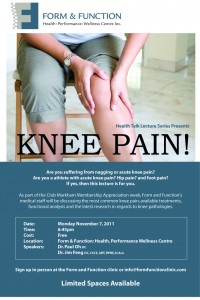
For those of you who have knee, hip, or ankle pain, this free lecture is for you. There is only a limited number of spaces available, so sign up today at the clinic or email us with your name and number. The lecture will be held at Form & Function on monday Nov 7,2011.
Take Care of Your Nails Chiropodist Jennifer Lam, Bsc (Hons), DPodM
Signs and symptoms of nail fungus plus tips on how to keep the healthy.
Edited by clinic director Oct 26,2011 due to incorrect designation on the part of the administration staff at Form & Function.
Take Care of Your Nails Chiropodist Jennifer Lam, Bsc (Hons), DPodM
Signs and symptoms of nail fungus plus tips on how to keep the healthy.
Edited by clinic director Oct 26,2011 due to incorrect designation on the part of the administration staff at Form & Function.
When wearing closed toed footwear, our feet have a tendency to sweat. Others tend to sweat excessively, on a daily basis. This can lead to embarassment and discomfort. Whether you sweat a lot or a little, here are some tips to help keep your tootsies drier and more comfortable when wearing closed toed footwear.
1) Avoid footwear made of plastic, rubber and fake leather.
2) Wear cotton socks and avoid synthetic fiber socks like wool to wick away moisture.
3) Dust your feet with baby powder or absorbent powder.
4) Spray an over-the-counter antiperspirant on the bottom of your feet.
5) If your feet are smelly, red and itchy…you may have athlete’s foot.
If you have concerns about athlete’s foot or your feet in general, book an appointment to see Jennifer Lam, the Foot Specialist/Chiropodist for a consultation.
Sitting, we all do it! Some for long periods, some short periods, some of us statically sit because we are concentrating on writing or driving, others may dynamically sit because we are multi-tasking, we all at some point conversationally sit while enjoying the company of others and we all love to leisurely sit and relax. The question is, are we most efficiently prepared to sit so sitting doesn’t become a position that takes away from the health of our system? When you look at our whole system, sitting which is a positional tweak takes parts away, in fact the major power source (hips) are inhibited to a large degree. How can we bring more of the body back into sitting?
On an average most Canadians spend half of their waking hours sitting. Sitting for extended periods of time can cause pain and decrease our function! Let us share with you how to assess a seated position assisting you to help become more efficient when they are sitting. Remember, even if someone is not complaining of pain while sitting, prolonged sitting can be the cause of pain during different movements as the body summates stress.
Come into Form & Function and let us help assist you in a full body functional movement screening to allow you to utilize your systems to the best of their capacity while limiting the discomfort of prolonged static positions.
Book an assessment with Christopher Chmiel – our physiotherapist who can help rehabilitate your postural concerns.
As Mr. Miyagi (from the Karate Kid) so eloquently stated “the key to life is breathing”. But to take this further, how efficiently do you breathe? During everyday life and low stress activities most people will breathe with their chest. Meaning the chest will expand with every inhalation and exhalation. This unnecessarily uses a lot of upper chest muscles when it only really requires your diaphragm.
To breathe with your diaphragm, think about breathing through your stomach. Start by lying down on your back and putting your hands on your chest and stomach. As you take a breath in, try to fill your stomach with air and it should rise. As you breathe out push the air out of your stomach and feel it fall. Try to feel that most if not all of the movement comes from your stomach and not your chest. When you can breathe well from your back, move to a seated position and then standing.
Breathing problems can also be an indication of other conditions. If you have ongoing issues such as shortness of breath, chest pain or difficulty breathing contact your medical doctor. Otherwise keep practicing and try to implement diaphragmatic breathing in your daily life.
As Mr. Miyagi (from the Karate Kid) so eloquently stated “the key to life is breathing”. But to take this further, how efficiently do you breathe? During everyday life and low stress activities most people will breathe with their chest. Meaning the chest will expand with every inhalation and exhalation. This unnecessarily uses a lot of upper chest muscles when it only really requires your diaphragm.
To breathe with your diaphragm, think about breathing through your stomach. Start by lying down on your back and putting your hands on your chest and stomach. As you take a breath in, try to fill your stomach with air and it should rise. As you breathe out push the air out of your stomach and feel it fall. Try to feel that most if not all of the movement comes from your stomach and not your chest. When you can breathe well from your back, move to a seated position and then standing.
Breathing problems can also be an indication of other conditions. If you have ongoing issues such as shortness of breath, chest pain or difficulty breathing contact your medical doctor. Otherwise keep practicing and try to implement diaphragmatic breathing in your daily life.
Plantar warts are viral infections that affect the skin on the bottom surface of the feet. Warts tend to grow inwards towards the skin as a result of our body weight which is directly applying pressure to these areas. In addition, warts are particularly difficult to treat due to the thick layers of skin on our feet. So how do we know if it’s a wart?
1) Warts have black dots in the middle of them.
2) Shaving down the wart will usually lead to pinpoint bleeding.
3) Warts tend to have broken skin lines.
4) Warts tend to hurt more if you squeeze them.
Avoid walking barefoot or in public/communal areas e.g. public shower, swimming pools.
If you suspect that you have plantar warts, please book an appointment with Jennifer Lam, the Chiropodist @ Form and Function Clinic for a foot assessment!